assetc 0.2.0 is out. It’s my asset compiler: it turns source assets - textures, glTF models, materials, shaders, fonts and game data - into runtime-friendly binary formats for games. Back in September I wrote about LOD controls in the C++ version; that one now lives on as assetc-cpp, and assetc itself has been rebuilt from scratch in Rust.
Why rewrite it?
The building blocks were ready. Over the previous week and a half I ported meshoptimizer and my math library matma to pure Rust, and assetc uses both: meshopt-pure for meshlets and levels of detail, matma for the math. With those in place the whole tool builds with cargo, the GUI runs on Bevy and egui, and the runtime side could become a plain Rust crate. The first commit of the Rust version landed on 30 October; 0.2.0 is tagged a bit over a week later.
What it compiles
| Source | Output |
|---|---|
png, jpg, tga | .ktx2 with full mip chains, sRGB or linear per glob |
.exr | HDR environment cubemap |
.cube | color LUT, as a strip or a 3D texture |
.gltf, .glb | mesh with meshlets and LODs, materials, textures, skin and animations |
.amat + textures by name | PBR material, ORM packed |
.ashader + SPIR-V, .acmat | shader interface and custom materials |
.ttf, .otf | SDF font with its atlas |
.anoise, .agradient, .apalette | generated textures, gradients and palettes |
folder *.atlas | packed texture with named frames |
.aschema, .adata, .agraph, .atree | typed game data, graphs and trees |
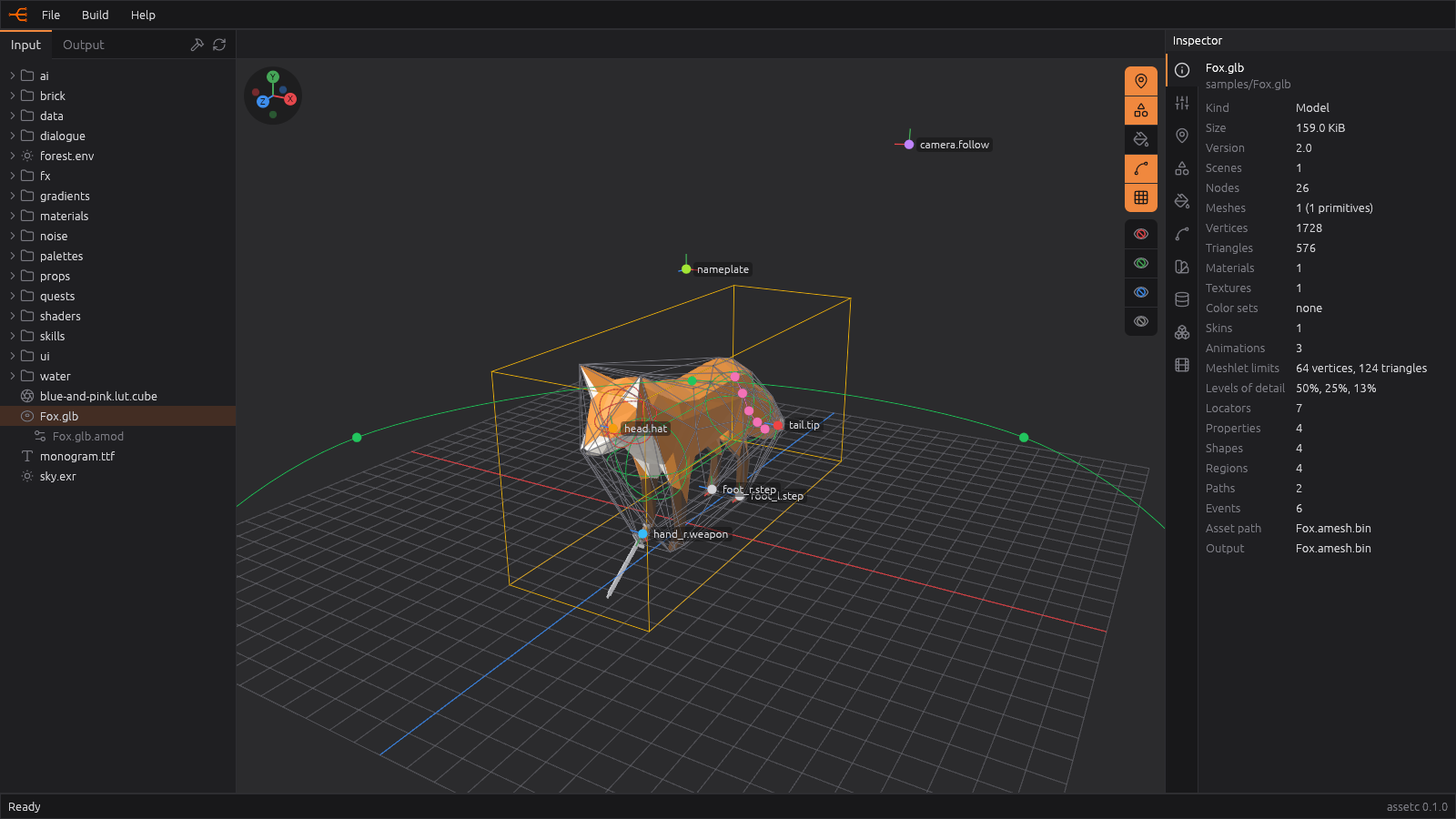
Meshes get octahedral-packed normals and tangents, meshlets (64 vertices / 124 triangles by default) and LODs at configurable ratios. Every binary format is little-endian, mostly chunked so a reader can skip what it doesn’t know, and each one has a detailed spec in docs/spec/.
Assets are referenced by 64-bit IDs - FNV-1a of the asset path (textures/Grass.png -> textures/Grass) - instead of file paths, so they stay stable across builds and source formats. A single manifest maps every ID to its output file. Embedded textures go into a shared store keyed by content, so the same texture used by two models is encoded once and shares one runtime handle.
The editor
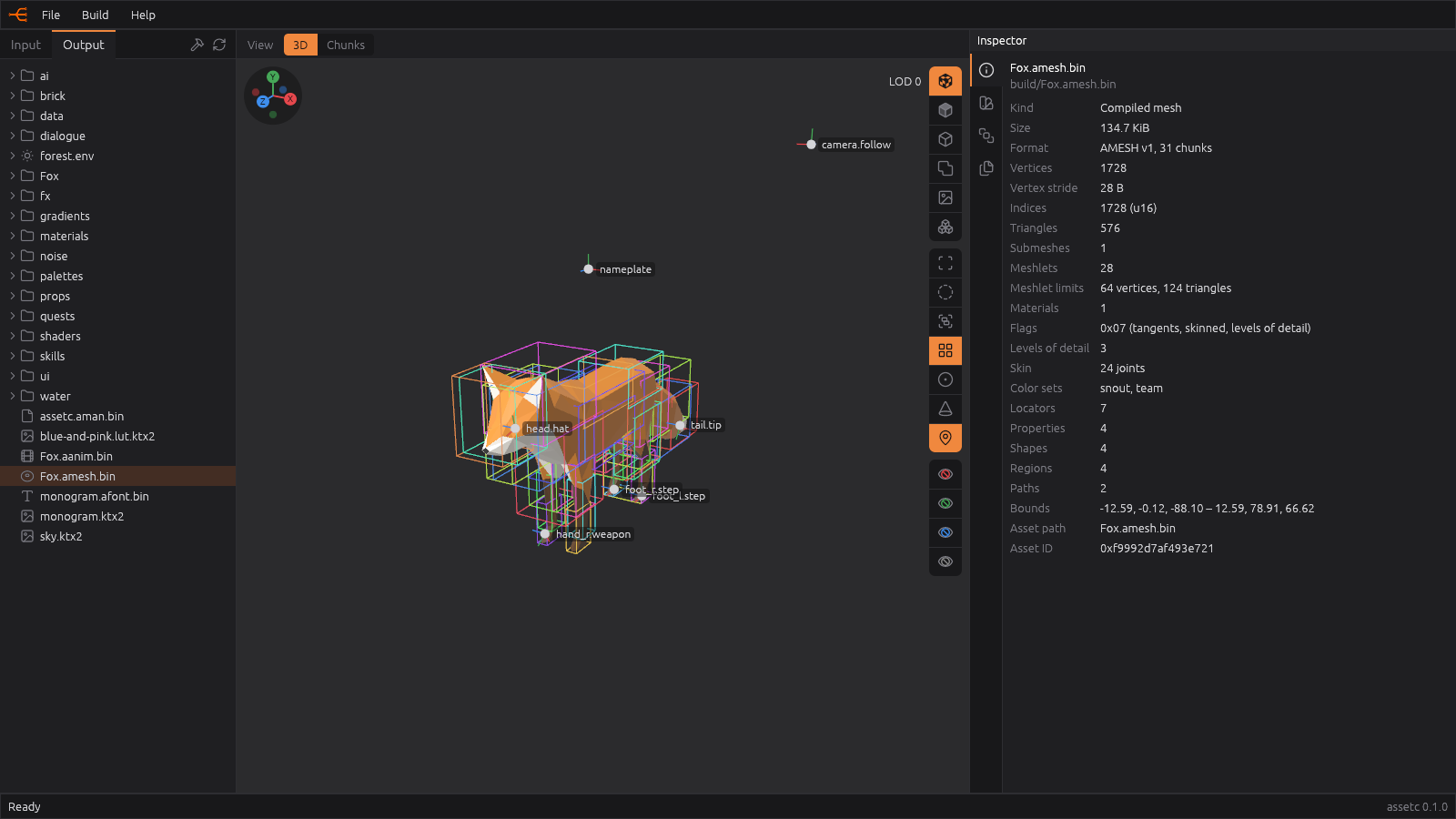
Running assetc with no arguments opens the GUI: input and output trees on the left, a 2D/3D preview in the middle and the inspector on the right. It previews textures channel by channel, models with locators and LODs, materials on a sphere, fonts, atlases, graphs and trees - and it edits the source files it understands.
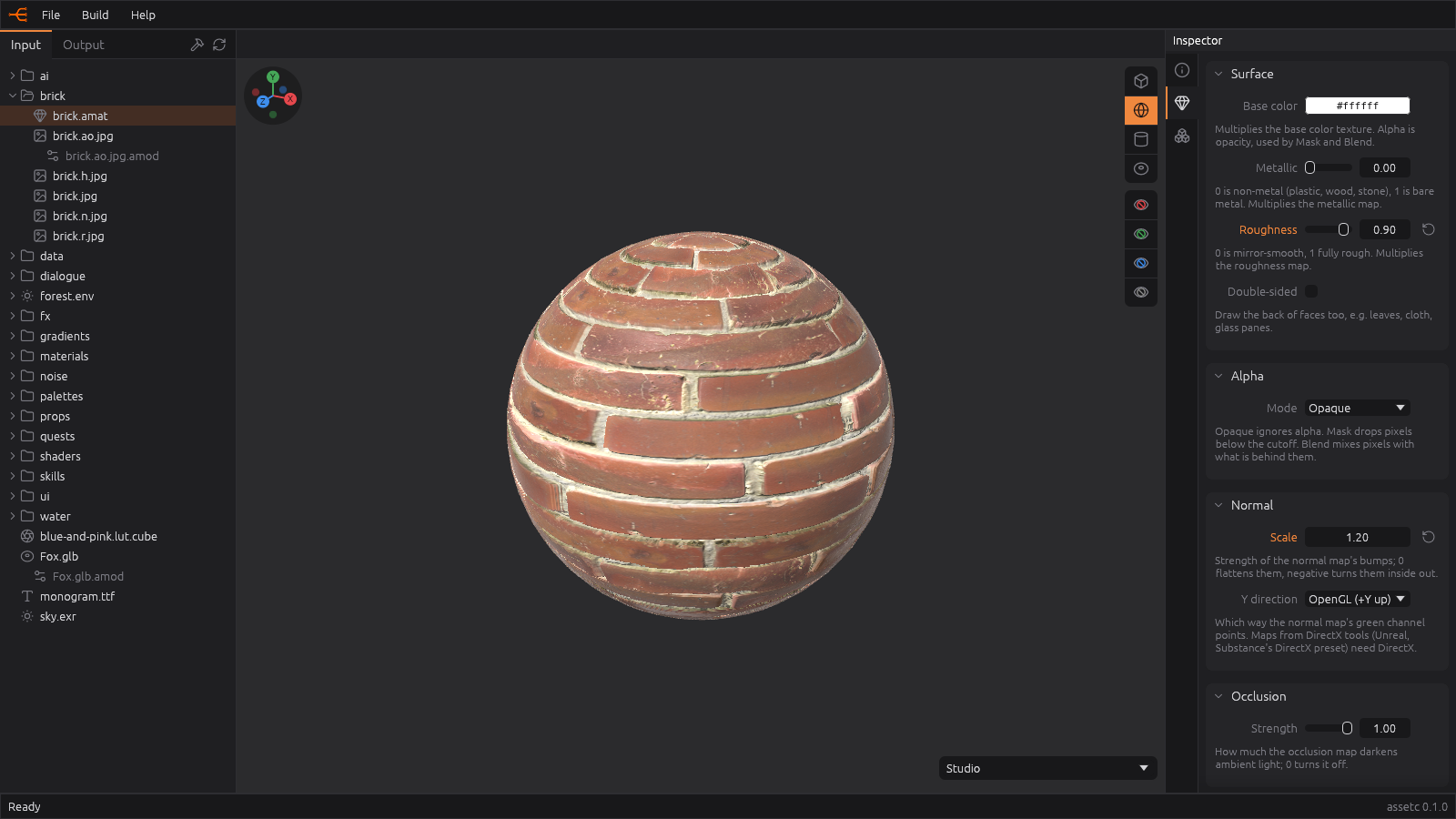
Per-file settings live in an .amod sidecar next to the source (Fox.glb.amod): mesh settings, locators, properties, shapes, regions, paths, vertex colors and animation events, all edited in the inspector.
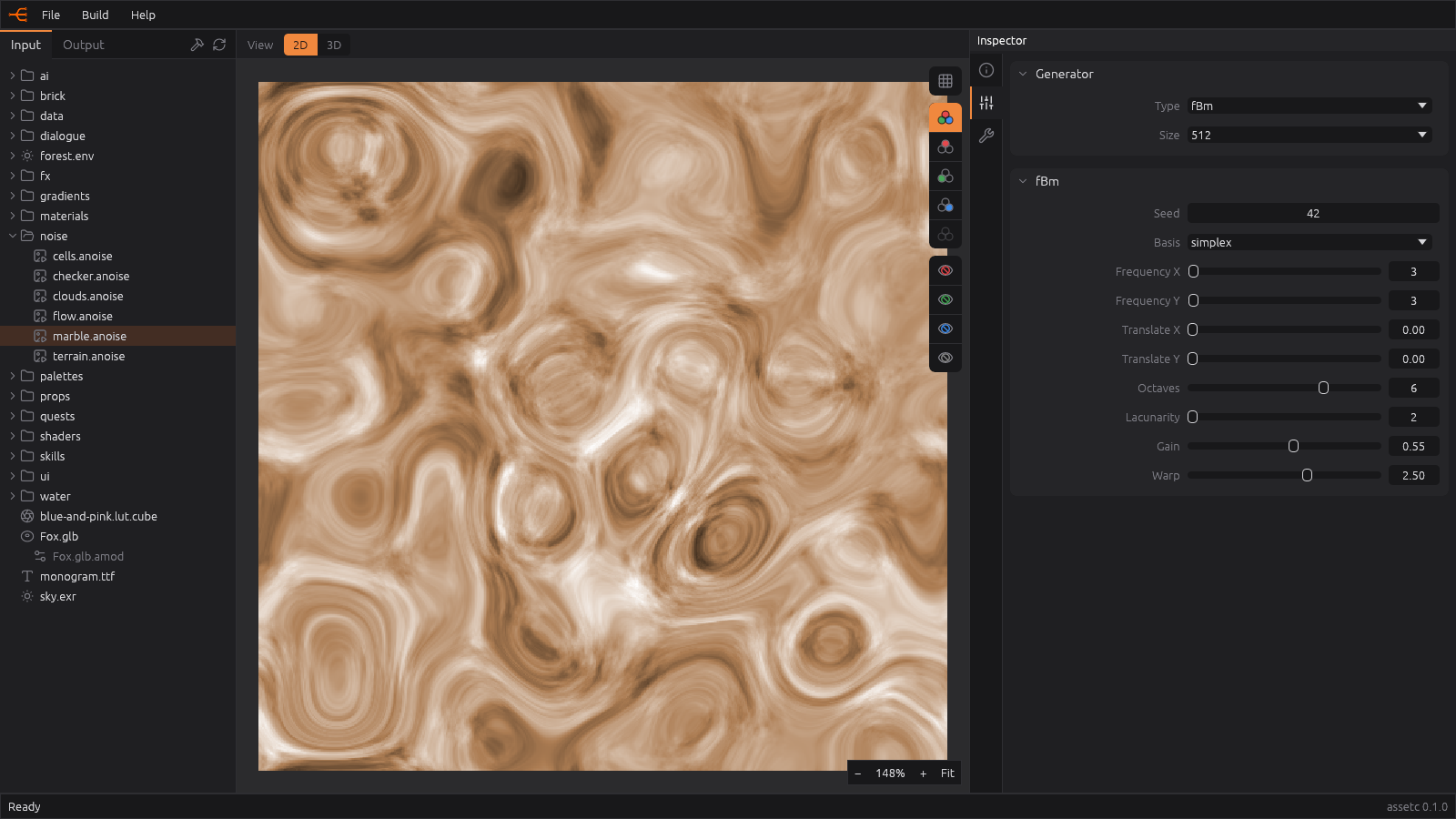
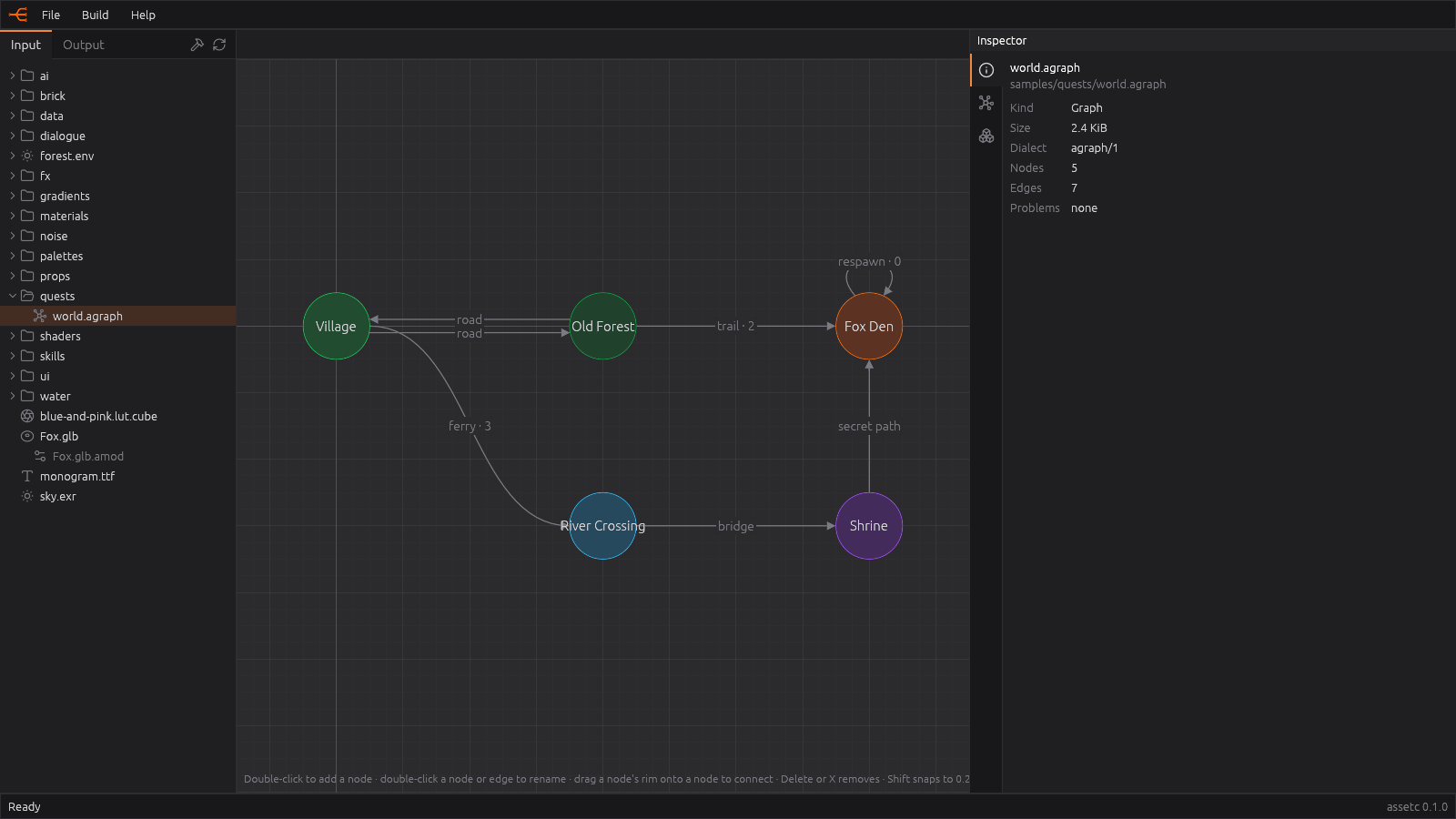
It’s not only art assets. Schemas, data instances, graphs and trees cover the game data side - quest maps, dialogue, AI - with references to assets and to other instances.
The Output tab inspects what the build actually wrote, so you can check meshlet bounds, LODs, the skin and locators on the compiled file rather than on the source.
The CLI
assetc init     # starter assetc.toml
assetc build    # compile input -> output
assetc watch    # rebuild only what changed, until Ctrl+C
assetc pack     # build, then bundle everything into one .pak
Like git with .git, it finds the project by looking for assetc.toml in the current directory and its parents. Every key is optional - an empty file builds assets/ into build/:
input = "samples"
output = "tmp/build"

[textures]
linear = ["**/*_n.png"]
no_mipmaps = ["ui/**"]

[meshes]
lod_ratios = [0.5, 0.25]

[pack]
alignment = 4096           # page-aligned files, for memory mapping

[targets.mobile]           # assetc build --target mobile -> tmp/build-mobile
meshes = { lod_ratios = [0.5] }
Targets are named variants of the settings that build into their own output, so a mobile build with fewer LODs is one flag away. The .pak keeps every file readable - or memory-mapped - in place.
The SDK
The game side is the assetc crate. It reads everything build and pack write, from a .pak or an output directory, into plain Rust values: textures with all mips, materials, meshes with unpacked normals and tangents, animations with sampling, SDF fonts with text layout, data, graphs and more. It depends on nothing but std - no Bevy, no glTF, none of the compiler’s code - so turning those values into GPU resources stays your engine’s job. API docs are on docs.rs.
[dependencies]
assetc = "0.2"
use assetc::{Assets, Kind, Mesh, Texture};

let assets = Assets::open("build/assetc.pak")?;     // or the output directory
for entry in assets.of_kind(Kind::Mesh) {
    let mesh: Mesh = assets.load(entry.id)?;
    println!("{}: {} vertices", entry.path, mesh.vertices.len());
}
let texture: Texture = assets.load_path("ui/fire.ktx2")?;
make demo packs the samples and opens a small Bevy app that loads all of them through the SDK only, the way a game would.
Getting it
Pushing the version tag builds release binaries for Linux x64, macOS (Apple silicon) and Windows x64 on GitHub. Or build it yourself with make install. The SDK is MIT or Apache-2.0, at your option.
Source, specs and docs for every feature are on GitHub.