assetc gets LOD controls
Small update to assetc, my asset compiler for turning glTF/OBJ sources into the engine’s binary .hmesh format: mesh LOD generation is now a first-class, tunable step instead of a fixed default.
Every submesh already got reduced LODs via meshoptimizer’s meshopt_simplify (stored in optional LODI/LODT chunks so the full-res path in IDXS/SUBM/MLET is untouched). What was missing was control over how that simplification runs, and the answer wasn’t always “just works” - meshopt_simplify is topology-preserving, so it refuses to collapse an edge unless exactly two triangles share it. Hard-edged or unwelded source geometry (duplicated verts at every seam, common straight out of a DCC export) can make almost every edge look like a boundary and stall a level at 0% reduction.
Now assetc.yml exposes it per-asset:
mesh:
  lod:
    ratios: [0.5, 0.25]  # target index-count fraction per level, from LOD0
    error: 0.05          # meshopt_simplify target_error (0..1), first attempt
    errorStep: 0.05       # relax target_error by this much per retry on a stall
    maxAttempts: 3        # retries at relaxed error before falling back
    sloppyFallback: true  # meshopt_simplifySloppy if still stalled after that
If a level keeps stalling, the encoder retries at a relaxed error limit up to maxAttempts, then optionally falls back to meshopt_simplifySloppy, which ignores topology entirely and always hits the target triangle count (at the cost of possibly distorting UVs/attributes a bit more).
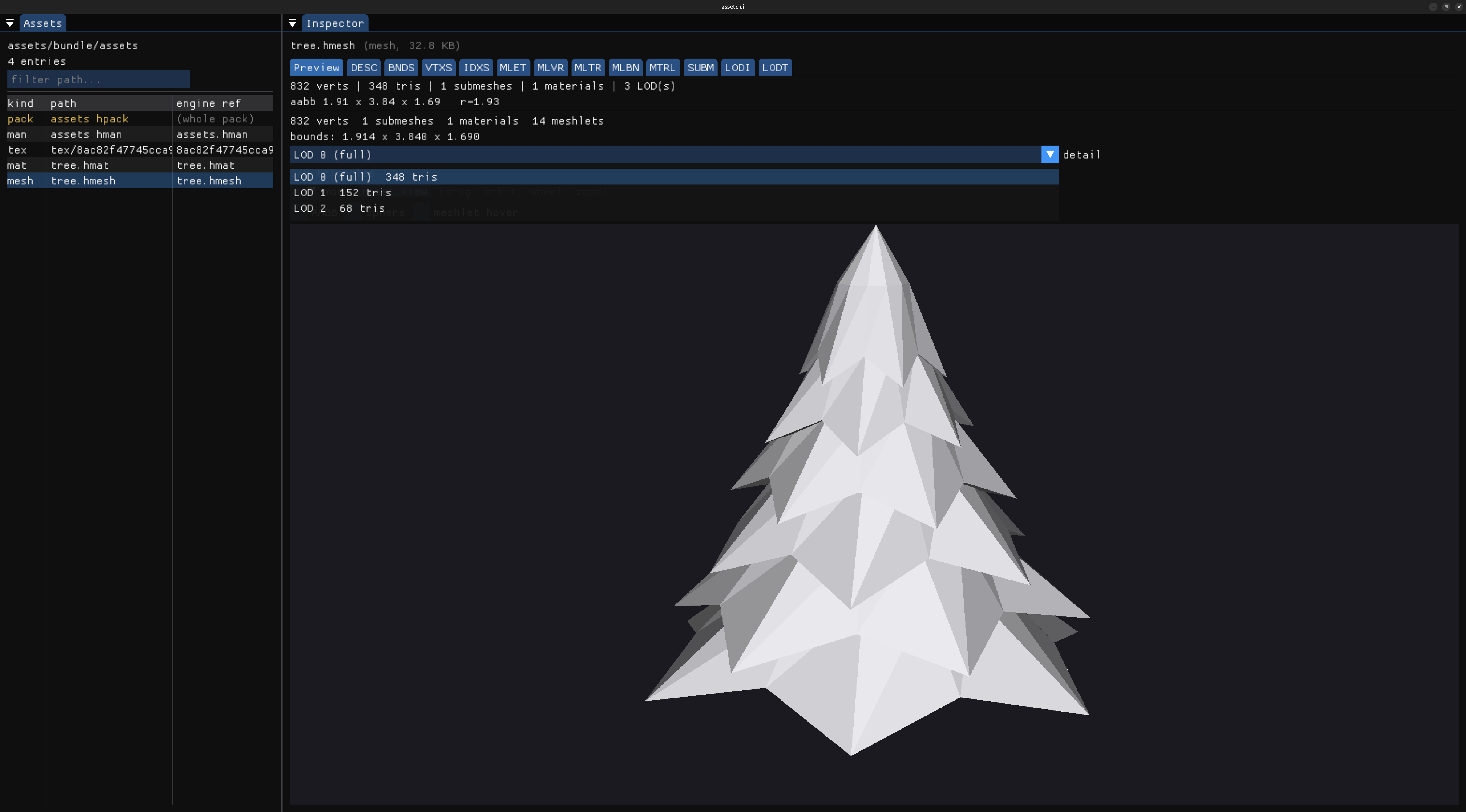
The inspector in assetc ui picked up a matching LOD selector, so you can flip between levels on a compiled mesh and see the triangle count and preview drop in real time:
Small piece, but one less thing to hand-tune per model.